The Cold War dominated the international arena for most of the second of half of the 20th Century. In fact, the war’s legacy remains relevant even today, with unresolved tensions that go to the heart of democracy and self-determination reemerging between the United States and Russia in areas ranging from computer hacking to Crimean annexation. During the Cold War, the Super Powers forced nations to pick sides, leaving very few countries to live undisturbed. Influence was power, and nearly every global action came down to simple math: It was “us against them,” Capitalist vs. Communist, a world where two major countries jockeyed for control. Given the extraordinary and continuing influence the Cold War had (and has) on international, domestic, and even personal affairs, understanding its drivers and influences remains key to understanding the world today and where it may head tomorrow. With the benefit of time, distance, and analysis, one can begin to gain such understanding by asking (and answering) several simple questions, including: Why did the world find itself in a Cold War between two Super Powers positioned halfway across the world? How could such a world come to be? And, perhaps most importantly, was this world inevitable? To answer these questions, one must review not only the context of the international stage during the first half of the 20th Century, but also how the U.S. and Soviet Union rose to domination following the Second World War. Also required: A deeper look at Stalin’s distrust of the capitalist West and the cultural hegemony of the two nations. Whether the Cold War – and all the fear, displacement, fighting-by-proxy, and, ultimately, uneasy peace that it encompassed – was inevitable is, of course, challenging to speculate as the only facts that exist are the ones that occurred. But by reviewing the factual events and decisions of three periods – before, during, and after WWII – within the prism of the reigning (and competing) ideologies and philosophies, one can assume that some variation of the Cold War was indeed inevitable, largely as a result of the Soviet/Communist skepticism of the capitalist West, Stalin’s aggressive actions in the years following the Second World War, and the inherent tensions of antithetical ideologies.
A first step in determining the Cold War’s inevitability is to understand the Soviet’s worldview, which in turn requires looking at their understanding and interpretation of history before WWII. The Soviets, and the Russians that preceded them, maintained a general and continual distrust towards the West. For centuries, the Western European states dominated high culture and wealth. From the Renaissance to Versailles to the Pax Britannica and beyond, European power was concentrated in the West. Yet even with these vast material advantages over their Eastern neighbors, Western nations regularly engaged in aggressive military campaigns to amass additional power and wealth. Prior to Germany’s 1941 invasion of Russia, the previous two military campaigns to enter Russian soil had come from Napoleon and Imperial Germany. Indeed, “the history of invasions of Russia in the modern period from the West is impressive Poland (1605-1613); Sweden (1700-1721); France (1812); Britain, France, and Turkey (1853-55); Germany, Austria, and Turkey (1914-1918); France, U.S., Britain, Japan, Romania, Greece, Czechoslovakia, and Poland (1918-1922).”(1) With few exceptions, all geopolitical threats came from the West. The Soviet state consequently held the “ideology of Russia’s ‘encirclement’ … which suggested that the country was surrounded by enemies in order to legitimize the regime. At the same time, as in the past, Moscow tried to punish the Western governments for their disrespect for the regime with an aggressive and uncooperative foreign policy.”(2) Indeed, given the litany of external invasions and incursions into internal affairs, one can see why the Soviets would be suspicious of other nations’ incentives; Moscow and Stalin believed the capitalist world would prefer if the Soviets ceased to exist. And in terms of considering the Cold War, this extreme, yet not entirely unreasonable, paradigm led Stalin to view subsequent Western motives through a lens of skepticism.
This pre-war narrative of Western aggression – and Soviet mistrust – that built the Cold War’s foundation continued though the mishandling of Hitler by France and Britain before the war began. Many see Operation Barbarossa as horrific evidence of German culpability (and capability). Following the initial German invasion, the Nazis were ruthless in their conquest of the “Untermenschen.” They slaughtered millions of Soviet citizens and destroyed swaths of land and infrastructure. The Soviet Union was pushed to the brink of collapse in its efforts to repel the Nazi advance. But in focusing on the period before WWII, Stalin and his advisors knew of the German intentions far before Barbarossa. The Reich had been on an anti-Jewish Bolshevik campaign since the early 1930’s and before, “Indeed, apart from the interlude occasioned by the tactical shift in German policy towards the USSR between 1939 and 1941, the propaganda onslaught against Bolshevism ranks as perhaps the most consistent strain of Nazi pre-war propaganda to be designed with both a German and a foreign audience.”(3) Hitler had been personally vocal in his distaste for Communism for years – even outlining parts of his plans for Lebensraum in Mein Kampf. Hitler’s alliances with Japan and Italy were part of the anti-Komintern movement, “the Anti-Komintern constituted an important component in the machinery that was designed ultimately to secure the annihilation of Bolshevism, an aim which even as late as February 1945 Hitler was still describing as the raison d’etre of his movement.” (Footnote 3) Stalin and others knew of the immense anti-Communist fervor that Hitler and others perpetuated. These movements helped cement the Soviet view that Germany in particular was an existential threat and must be defanged, never allowed to become a major power again. They also helped establish the mindset that would lead to the Cold War.
The Soviets’ encirclement narrative was further supported by British and French appeasement of Hitler, as well as their exclusion of Soviet representatives from key pre-war meetings. During Hitler’s militarization of Germany, and through the remilitarization of the Rhineland and annexation of predominantly German populations, the French and British appeased Hitler in an attempt to prevent another large scale European War. In cases such as the Munich Conference, the 1938 meeting where Great Britain, France, and Italy allowed Germany to annex areas of Czechoslovakia, the Soviets were excluded and had to watch from the side, as a dangerous enemy grew stronger. With German intentions to destroy the Soviet Union already well understood, the Western powers’ willingness to remilitarize Germany caused Stalin to believe the worst: That the West hoped Germany and the Soviet Union would fight a gruesome mutually destructive war, “[Stalin] suspected that [the French and British] saw ‘fascist’ power as a suitable antidote to socialism. Stalin also blamed them for having excluded him from decision making. The USSR had been denied recognition as a great power and put into a position of dangerous isolation. Would the two West European countries continue their policy by directing German expansion against the Soviet Union? Were they willing to exploit Hitler as a tool to fight and destroy the USSR as their ‘class enemy’?”(4) While the Soviet fears might have been unfounded during the Munich Conference, during the Second World War many indeed did hope for an exhausting and destructive war between the two nations. The West’s willingness to tolerate the remilitarization of an obviously aggressive Germany, as well as their sidelining the Soviet Union unsurprisingly led Stalin to further distrust the West. As the War began, a key component for the pending Cold War – namely, mistrust – was already established.
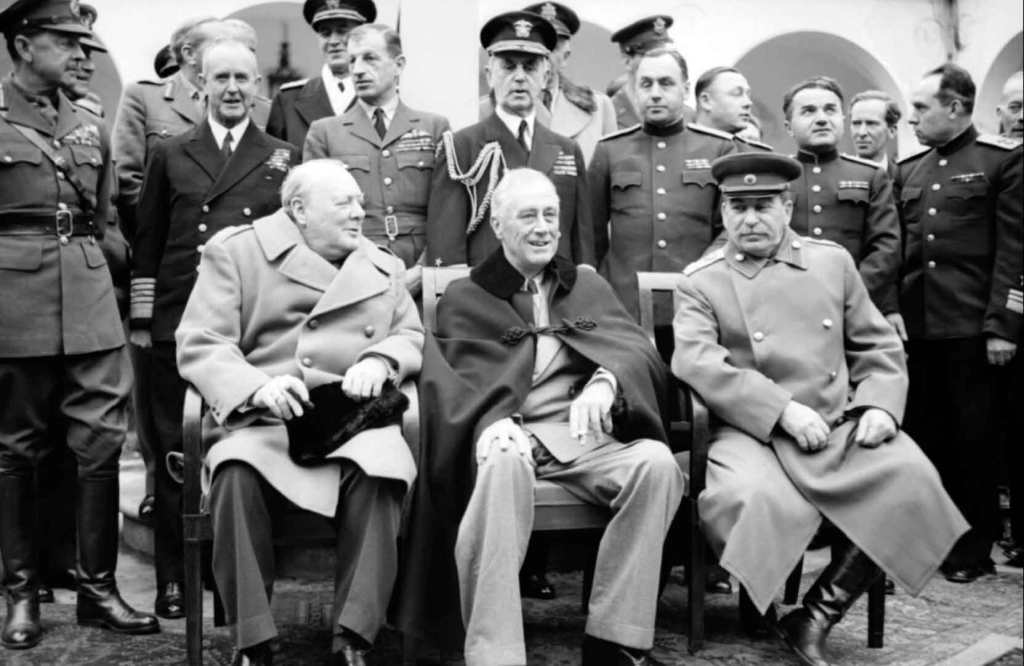
As the War progressed, that mistrust was still apparent, and the path to Cold War grew warmer. As the Grand Alliance victory crystalized, negotiations began – during the War period itself – to proactively create a post-war world filled with spheres of influence. Throughout the War, Allied leaders met at three separate conferences to discuss their plans. But this war was different from past wars, as Allied leaders could secure almost complete control over territories that their armies occupied. Stalin stated this phenomenon, “’This war is not as in the past,’ … ‘Whoever occupies a territory also imposes on it his own social system’ as far ‘as his army can reach.’”(5) This unique reality led to an obvious problem for post-war agreements when the leading nations such as the United States or the Soviet Union held differing views on the future of various countries or territories. This problem was further complicated by the distrust among the Allies, “British policy makers were never sure what Stalin intended, and like their American counterparts they fluctuated about how to respond to the challenge.”(5) All the British and Americans could assume was that Stalin and the Soviet empire would act in their own self-interest – specifically in securing Soviet security by establishing regional hegemony in Eastern Europe. Churchill, aware of this reality, showed his understanding of this post-war order in his creation of the Percentages agreement in 1944. In this meeting Churchill and Stalin engaged in the same back door diplomacy that had been used by imperialists throughout the 19th Century. The goals were clear, “if the Soviets would not oppose Churchill’s efforts to recover the empire that Britain temporarily lost to Japan, Churchill would not oppose Stalin’s efforts to realize the legitimate territorial aspirations of the Soviet Union.”(6) The Percentages agreement designated which nation’s ideology would dominate in designated areas. The agreement held as Stalin and Churchill respected each other’s autonomy in the deliberated areas, such as Greece and Romania, during times of crisis, “[Churchill] did not have to worry about any Soviet disapproval of British pacification of the Greek Left; Stalin honored his understanding with Churchill and remained silent on Greece. When Stalin intervened in Rumania in February 1945 to install a Communist-dominated government there, Churchill kept his peace.”(6) Even during the war the Allies knew that the post-war world would be divided into spheres of influence with “imperialist” nations creating economies and political systems that were friendly to their interests. Indeed, these agreements only strengthened the foundation on which the Cold War would sit.
But it wasn’t just European theater activities during the War that helped make the Cold War inevitable; important indicators of the Cold War’s start also came in the Pacific, with the Allied victory over Japan. In February 1945, the U.S., UK, and USSR leaders met in Yalta to review post-war European plans. But President Roosevelt also had an eye further east; one of his key objectives was to gain Soviet assistance in defeating Japan. Stalin accepted Roosevelt’s proposition and stated that he would assist three months after victory in Europe. Then events evolved. Roosevelt died in April, succeeded by Harry Truman. The rise of American globalism, Truman’s suspicion of the USSR, as well as high-estimated casualty rates from a Japanese mainland invasion led the new President to initiate the nuclear era. Truman agreed to drop Little Boy and Fat Man, the two American nuclear weapons, on Hiroshima and Nagasaki. Contrary to popular belief, the nuclear warhead detonations were not devastating to the Japanese. Other conventional bombings had wrought similar destruction, “In the three weeks prior to Hiroshima, 26 cities were attacked by the U.S. Army Air Force. Of these, eight — or almost a third — were as completely or more completely destroyed than Hiroshima (in terms of the percentage of the city destroyed).”(7) This reality, coupled with the astounding fact that the Japanese Supreme Council did not meet until three days after the bombing of Hiroshima (one would imagine that if Hiroshima were as devastating as many believe, the Supreme Council would have met much earlier after the detonation), raises a key question that provides insights into the Cold War’s inevitability: Why did the Japanese surrender and cite the bombs as a reason?
The introduction of the Soviet Armed Forces into the Pacific campaign meant the end for Imperial Japan’s ability to draw out the war, while the bombs gave the Japanese Elite an easy excuse to settle for peace. Prior to the Soviet entrance into the war, the Japanese had two options to attain better peace terms with the Americans, “The first was diplomatic. Japan had signed a five-year neutrality pact with the Soviets in April of 1941, which would expire in 1946. A group consisting mostly of civilian leaders and led by Foreign Minister Togo Shigenori hoped that Stalin might be convinced to mediate a settlement between the United States and its allies on the one hand, and Japan on the other.” This was not an unrealistic thought; the Soviets would not want an excessively large American power in the Pacific, as, “any increase in U.S. influence and power in Asia would mean a decrease in Russian power and influence.” (Footnote 7) The second option for the Japanese was to make the war too costly for the United States to remain committed to Japanese unconditional surrender, “They hoped to use Imperial Army ground troops to inflict high casualties on U.S. forces when they invaded. If they succeeded, they felt, they might be able to get the United States to offer better terms.”(7) But the introduction of Soviet troops into the Pacific War and their conquering of Manchuria left both options no longer available, “it would not be possible to fight off two great powers attacking from two different directions. The Soviet invasion invalidated the military’s decisive battle strategy, just as it invalidated the diplomatic strategy.”(7) The Japanese elite knew that Soviet occupation would mean the tearing up of the Emperor and Japan’s social fabric; lacking a better option, the Japanese surrendered to the U.S. The United States agreed to keep the title of Emperor – though they stripped his political powers – and created a new democratic Japanese constitution with a market economy in place.
The expansion of American Globalism to much of Japan’s territories upset Stalin – and helped set the stage, inevitably, for important Cold War components. The Soviet leader felt cheated by the Americans through his lack of involvement in settling post-war Japan. But the Soviets had made important Asian inroads. By the time the Japanese government surrendered, the Soviets had already expanded territorially into Asia. They had gained control over territories such as Karafuto, the Chishima Islands and ports such as Arthur and Dalian, which provided significant strategic benefits. The Soviets also occupied parts of Korea. They established the two occupation zones along the 38th Parallel, with the Soviets and Americans establishing friendly governments along the line. This artificial separation would help lead to the Korean War later down the line. By the end of the Pacific war, the two new Super Powers were already jockeying for position in their new post-war world.
While dropping atomic bombs may not have been the singular reason for the Japanese surrender, the development and eventual utilization of the bombs themselves furthered the growing divide between the United States and the Soviet Union – and provided another reason for the Cold War’s inevitability. During the Second World War, Stalin had planted spies within the Manhattan Project; he knew of the American attempt to create a nuclear bomb. Unfortunately for Stalin, the USSR was a battleground during the extensive German campaign, leaving the Soviets few resources available to develop the bomb. This did not stop Stalin from seeking to obtain one himself, “[Stalin] decided in December 1942 to launch a small-scale atomic project… This decision, taken at a time when Leningrad was under German siege and the heroic battle of Stalingrad was being fought, could not have been taken in the hope of producing the bomb for use in the war. It made sense only as a hedge against a possible German or American bomb in the post-war world.” (Footnote 8) After Hiroshima, Stalin realized the vital role these weapons would play in the post-war world, “Stalin summoned the Russian scientists. ‘A single demand of you, comrades,’ Stalin intoned, ‘provide us with atomic weapons in the shortest possible time. The equilibrium has been destroyed. Provide the bomb–it will remove a great danger for us.’”(8) Even during the war itself Stalin was already thinking about the structure of the post-war world. The securing of nuclear warheads was necessary for Stalin to maintain the equilibrium he sought with American power, indicating his view of the delicate American-Soviet power dynamic. The Soviet’s securing the nuclear capability – particularly as an avenue to equilibrium – served as an important cornerstone the drove the creation and endurance of the impending Cold War.
While pre-WWII and actual WWII activities created – and then built on – the Cold War foundation, the structure was cemented, and the Cold War launched, through significant post-WWII events. One such event that led to the Cold War’s inevitability came in the rift between the Allies over their treatment of German reparations. Stalin viewed the German people and nation as the largest existential threat to the Soviet Union. Stalin also believed that Germany, which led devastating campaigns into Russian soil in both World Wars, would rise again into power unless incredibly harsh and punitive measures were taken to ensure a weak Germany. The Soviets wanted a poor Germany with large reparation payments for the destruction caused by the war. The Americans and British were far less punitive, “[Soviet Union] leaders proposed that Germany should pay $20 billion in compensation to the victors, one half of which should be reserved for the USSR. By contrast, the British refused to name any fixed amount; after all, no one could be sure exactly what Germany could afford. For their part the Americans would accept the Russian figure only as a basis for negotiation, rather than as a final demand.”(9) The Soviets and their Allies considered this new German question from vastly different perspectives. While Stalin had even toyed with the idea of dismembering Germany, the British sought to make Germany commercially successful, “the relevant ministerial body… had formulated a very broad strategy. Essentially it aimed to give priority to security rather than to commercial considerations. Any possible future German aggression would be prevented by the dismantling of the country’s war potential. The country’s peacetime industries would be allowed to flourish.” (Footnote 9) These extreme views of a post-war Germany showed the difference in thought between the two sides. They also deepened the probability – certainty? – of the future mistrust that defined the Cold War. Stalin viewed a strong Germany as unacceptable and as an existential threat, while the Americans and British sought to strengthen the German economy while defanging the German military.
Many developments – some strategic, some social, some economic, some political – all connected to lead to the Cold War’s inevitability. But even if, after this evidence, doubt remains, that doubt is mitigated by a review of the Marshall Plan, which, with its resulting hostility and disgust by the Soviet delegation, marked the informal beginnings of the Cold War. After the infrastructural and economic devastation that World War II left in Europe, the United States deployed the Marshall Plan to aid European nations that sought financial assistance. At war’s end, the U.S. was one history’s wealthiest countries. In contrast, the European nations were in economic shambles. The weak economies and infrastructure scared Truman and others that Communist could gains strength in Western Europe, as Communist Parties thrived in poor economic environments. The resulting Marshall Plan offered $12 billion in aid – equivalent to $120 billion today. The aid was publicly available to any European nation that applied, including those in Eastern Europe and the Soviet Union. Truman knew the Soviets and Eastern European nations would not accept. Even if they had, it’s unlikely the Republican U.S. Senate would have approved the Plan. Either way, the Soviets would not see Marshall Plan assistance. The deployment of Marshall Aid was to be centralized and would enable American influence on nations that accepted the aid. This proposition was unacceptable to the Soviets. They viewed the Marshall Plan as, “an extension of the Truman Doctrine in which financial aid would be used as an additional means of applying political pressure on European states, particularly those in Eastern Europe.”(10) In fact, the Soviets interpreted the Plan as a way to begin forming a Western-European bloc, “[The Marshall Plan was] a project for extending France’s Monnet Plan for modernisation and re-equipment to other countries, with the aim of using this as the basis for the creation of a US-led West European bloc.”(10)
Beyond furnishing a Western-European bloc, the Soviets saw the Marshall Plan as an American attempt to gain influence in the Soviet bloc as well. This view was further cemented when Molotov and the Soviet delegation received word that German occupation zones would receive large amounts of aid, “Molotov received secret information from Moscow that the British and Americans had agreed that Germany would be central to any European reconstruction plan and that they would oppose the payment of reparations to the Soviet Union from German current production. The receipt of this telegram coincided with the beginning of a hardening of the Soviet position at the conference.”(10) Stalin and others interpreted the goals of the Marshall Plan as hostile to the Soviet Union, providing proof of hawkish American policy. It deepened an inability for the two nations to cooperate in the post-war world, “the Marshall Plan… coming on top of the Truman Doctrine and other negative developments… confirmed Moscow’s worst fears about the prospects for collaboration, negotiation and agreement with the West.”(10) Further, “What the Marshall Plan seemed to signify was the final failure of what can be called an integrationist strategy in foreign policy-the political and economic integration of the USSR and its zone of influence into a wider European and international constellation. With the coming of the Marshall Plan, that kind of integration, it seemed to Moscow, was only possible on the basis of giving up vital Soviet positions and interests in Eastern Europe.”(10) By the time the Soviets and other Eastern European nations declined the aid, the damage was done. As Molotov stated about the Plan, “The imperialists were drawing us into their company, but as subordinates. We would have been absolutely dependent on them without getting anything useful in return.”(11) The Soviets no longer believed, not that it truly ever had, that the United States had pure motives. Instead, they saw the United States attempting to gain more influence and power at the expense of the Soviet Union, pushing the two countries deeper towards – and even into – the Cold War.
In analyzing the Cold War’s inevitability, one must question the extent to which the events that preceded the Cold War were bound to occur, along with the extent that Stalin created (or responded to) conditions for the Cold War to occur. It must not be forgotten that, “Stalin was…an ideologue… a Marxist-Leninist… [and] ideology ‘often determined’ the behavior of such regimes. Ideology was not simply a rationale or a justification but a source of behavior and a point of reference for understanding the world.”(12) Stalin’s source of behavior led him to view the world in a very particular way, “Most important… Stalin was a revolutionary. ‘He never gave up on the idea of an eventual world revolution, but he expected this to result … from an expansion of influence emanating from the Soviet Union itself.’ More ominous still was the fact that Stalin fused Marxist internationalism with czarist imperialism”(12) This ideology became apparent in Stalin’s handling of domestic and foreign affairs. Certainly, he sought to maintain a strong Communist presence in Eastern Europe for security reasons. But he also believed deeply in the eventual collapse of the capitalist states and rise of communist revolution, “According to Marxist-Leninist doctrine, there was a predetermined series of successive ‘historical formations’ from capitalism to socialism and communism… Therefore capitalism had to be seen as the inferior sociopolitical order that had to be fought on moral grounds and would be eliminated in the end by historical necessity. This implied that both domestic and international relations had to be handed on the basis of ‘class’ criteria.”(13) Stalin’s analysis created an openly expansive and potentially violent paradigm that understandably scared the United States, as well as the rest of the capitalist world. Under Stalin’s interpretation, little room existed for cooperation between the two Super Powers; both sides viewed the other’s system as inferior and antithetical to their own.
For the United States, the Soviets became an existential threat. In response, the Western leader created a string of allies: “The empire established by the United States in Western Europe … came about belatedly, only as other nations felt threatened and as the United States felt increasingly endangered… Nonetheless, the United States struggled to overcome its sense of vulnerability and defined its safety in multilateral terms of common security.” (12) This approach generated a stark difference between the United States and the Soviet Union. The Soviet Union created a vast empire with the intention of eventual global domination with rulers sitting in Moscow. In contrast the United States sought not domination, but survival, “American officials… were not seeking economic gain. Constrained by domestic politics… and preoccupied with correlations of power in the international system, they sought to contain Soviet influence and Communist power… the United States established its own empire, but it was an empire of liberty, an empire of diversity, an empire that allowed for the exercise of autonomy by allies who were happy to be part of it.” (12) As the existence of a common enemy – whether Germany or Japan – disappeared, the relationship between United States and Soviet Union became increasingly doomed. Their worldviews were antithetical; each felt threatened by every move the other made, unable to determine if motives were pure or self-interested. Stalin’s commitment to a Marxist-Leninist ideology with a hint of imperialism scared the United States. Inevitably, a massive and bilateral security dilemma evolved and hardened: The Cold War was born.
Bibliography
- Molotov, Vyacheslav Mikhaylovich, Feliks Ivanovich Chuev, and Albert Resis. Molotov Remembers: Inside Kremlin Politics. Chicago: I.R. Dee, 1993.
- Roberts, Geoffrey. Molotov : Stalin’s Cold Warrior. 1st ed. Shapers of International History Series. Washington, D.C.: Potomac Books, 2012.
- Weeks, Albert Loren. Assured Victory: How “Stalin the Great” Won the War but Lost the Peace. Santa Barbara, Calif.: Praeger, 2011.
- Reynolds, David. “From World War To Cold War: The Wartime Alliance And Post-War Transitions, 1941–1947.” The Historical Journal 45, no. 01 (2002).
- Resis, Albert. “The Churchill-Stalin Secret “Percentages” Agreement on the Balkans, Moscow, October 1944.” The American Historical Review 83, no. 2 (1978): 368.
- Roosevelt, Franklin D., Joseph Stalin, and Susan Butler. My Dear Mr. Stalin : The Complete Correspondence between Franklin D. Roosevelt and Joseph V. Stalin. New Haven: Yale University Press, 2005.
- “Andrei Vyshinsky Soviet Response to Truman Doctrine: HistoryWiz Primary Source.” Andrei Vyshinsky Soviet Response to Truman Doctrine: HistoryWiz Primary Source. Accessed October 05, 2016.http://www.historywiz.com/primarysources/vyshinsky.html.
- “Winston Churchill “Iron Curtain” Transcript.” Winston Churchill “Iron Curtain” Transcript. Accessed October 05, 2016. http://www.speeches-usa.com/Transcripts/winston_churchill-ironcurtain.html.
Footnotes
- Payne, Matthew. Comments to first draft of paper.
- Shlapentokh, Vladimir. “Perceptions of foreign threats to the regime: From Lenin to Putin.” Communist and Post-Communist Studies 42, no. 3 (2009): 305-324.”
- Waddington, L. L. “The Anti-Komintern and Nazi Anti-Bolshevik Propaganda in the 1930s.” Journal of Contemporary History 42, no. 4 (2007): 573-94.
- Wettig, Gerhard. Stalin and the Cold War in Europe: the emergence and development of East-West conflict, 1939-1953. Landham, Md: Rowman & Littlefield, 2008.
- Gardner, Lloyd C. Spheres of influence: the great powers partition Europe, from Munich to Yalta. Chicago: I.R. Dee, 1993.
- Resis, Albert. “The Churchill-Stalin Secret “Percentages” Agreement on the Balkans, Moscow, October 1944.” The American Historical Review 83, no. 2 (1978): 368.
- “The Bomb Didn’t Beat Japan … Stalin Did.” Foreign Policy. Accessed December 18, 2016. http://foreignpolicy.com/2013/05/30/the-bomb-didnt-beat-japan-stalin-did/.
- “Stalin and The Bomb.” Stalin and The Bomb. Accessed December 18, 2016. https://www.idsa-india.org/an-oct9-6.html.
- Farquharson, J. E. “Anglo-American Policy on German Reparations from Yalta To Potsdam.” The English Historical Review CXII, no. 448 (1997): 904-26.
- Roberts, Geoffrey. “Moscow and the Marshall plan: Politics, ideology and the onset of the cold war, 1947.” Europe-Asia Studies 46, no. 8 (1994): 1371-386.
- Molotov, Vyacheslav Mikhaylovich, Feliks Ivanovich Chuev, and Albert Resis. Molotov Remembers: Inside Kremlin Politics. Chicago: I.R. Dee, 1993.
- Leffler, Melvyn P. “The Cold War: What Do “We Now Know”?” The American Historical Review 104, no. 2 (1999): 501.
- Wettig, Gerhard. Stalin and the Cold War in Europe: the emergence and development of East-West conflict, 1939-1953. Landham, Md: Rowman & Littlefield, 2008.
 Gradually Then Suddenly